The purpose of a research process is to identify, locate, assess and analysis information to help your ethnographic research. To achieve this I must brake my research process down into three key elements:
- Problematise my approach when conducting a media ethnography
- My research plan
- The schedule of my research
Problematisation
As discussed in Week 2’s blog post, problematisation essential means a problem that requires a solution. In this case I will be investigating the impact of my media niche (Joe Rogan’s Podcast) and determining that if by listening it has shifted viewers ideologies and perception on important issues. For example, prior to listing to the podcast the viewer was anti-vaccination but after listening to the podcast turned pro-vaccinations. It is through this investigation and ethnographic research that I hope to be better able to determine the value of podcasts as an independent media that is capable of altering viewers beliefs and their paradigm of the world.
When investigating my research I plan to target existing viewers of the podcasts and also those unfamiliar of the niche and introduce them to the podcast and establish that if by listening the viewers ideologies have remained the same or changed.
Additionally, I hope to explore new experiences around my media niche and gain an insight into the environment of how viewers listening to the podcast (e.g. Phone or laptop), where they listen, when they listen & why they listen to help provide interesting data as a result of my ethnographic research.
Research Plan
The research plan is to help move your ethnographic research from general to specific. I plan to make this switch by using both observation and autoethnograpic research methods when conducting my research. The way in which I will be using both methods to gain information can be seen in the diagram attached below.
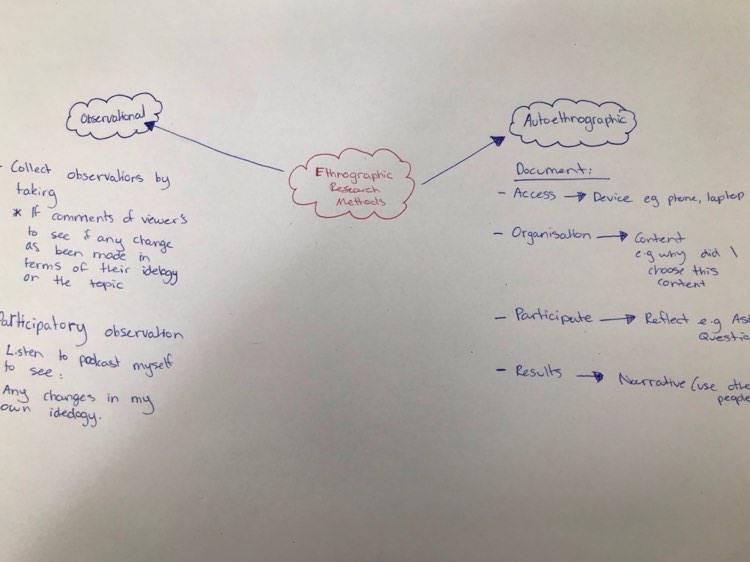
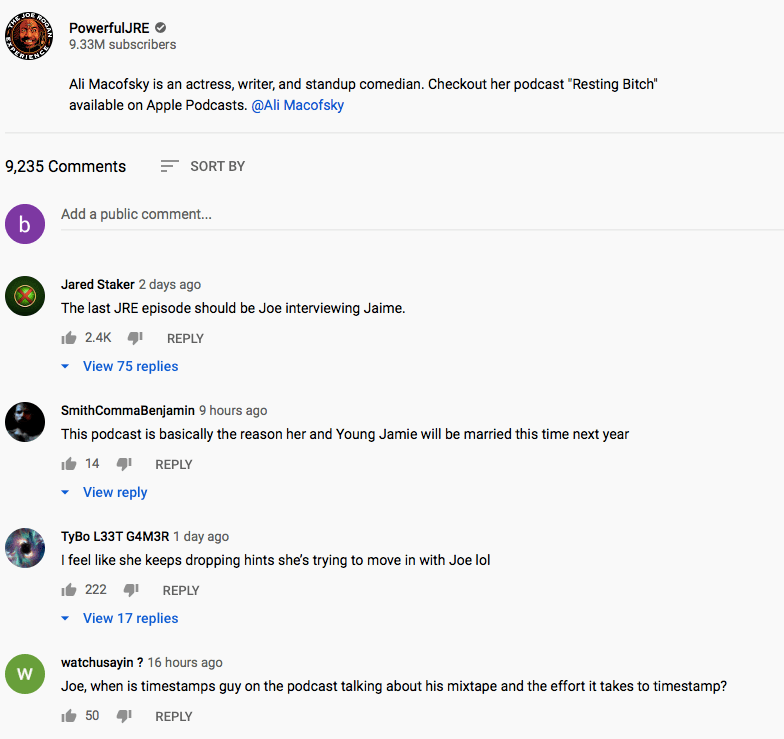
I will record the information gained from both research methods on a word-document on my laptop where I will document my observations on the topics outline in the diagram attached above. I will also be taking screenshots from viewers comments on the podcasts streaming platforms such as Youtube to see if it has changed the viewers perception or belief on the topic. I will be recording this information weekly to ensure correct and current information is provided.
Research Schedule
Also known as research protocol, the research schedule is essential an outline of what I’ll be recording and when. This will help enable me to keep my ethnographic research relevant and concise. Below is an outline of my research schedule from Week 4- 7.
Week 4: I will be researching the access to the podcast. Meaning if my experience of my niche is altered by using it on my phone or laptop. How to find, where can you stream it (Youtube etc), where to find it on social media, if my experience is altered when listening at home compared to in the car.
Week 5: I will be studying the chosen content off podcasts:
#459 – Dr Rhonda Patrick: https://www.youtube.com/watch?v=FApCVOXoweU
#543 – Sam Harris: https://www.youtube.com/watch?v=ZA106wrMUe4
#1246-Alex Berenson & Dr Michael: Hart: https://www.youtube.com/watch?v=YHwSmwEwmV4
As I believe these are some of the most controversial and influential podcasts that might result in the changing of viewers ideologies towards the topic and as a whole, with that being my key research in week 5.
Week 6: Will be research of how other people are viewing the podcast, how are they finding the podcasts.
Week 7: I will be viewing other podcasts such as The Monday Morning podcast. It is from this podcast I will be researching if it is having more, less or the same impact in regards to altering their current beliefs and ideologies on important issues.
Overall, it is by braking down these three elements that I will be able to clearly and more precisely undertake my research process which will in turn enable me to explore new experience within my media niche to provide interesting and relevant information.
Reference
- Geertz, Clifford (1973) ‘Thick description- Toward an interpretive theory of culture,’ in The Interpretation of Cultures, Basic Books New York.
#bcm241 #medianiche #ethnography #joeroganexperience
 highfieldonline.photo.blog
Leave a comment