The internet and technological devices have become increasingly relevant currently for students learning, with universities presently shifted to a more digital environment due to the circumstances of the world. Making devices such as laptops, phones, desktops and tablets essential to how a student may choose to connect, engage and learn content online. Thus why my research explored what devices students are using and prefer when learning online to provide more awareness to what device is most effective, whilst also addressing external factors of how comfort, distraction, value and efficiency lead to the devices chosen by students.
For this project I used the primary research method of an online questionnaire alongside secondary research consisting of academic and websites articles in order to collect meaningful information and data to provide greater clarification regarding:
- The current devices students are using
- Factors as to why students use their chosen device
- Most effective device for students to use for online learning
Findings
It is through my research, involving a survey of current university students that 90% within the sample use a laptop for online learning, this is due to the fact 80% of students prioritise compatibility and efficiency alongside storage. The research highlighting the reason why students predominantly use laptops for online learning is because it provides them with the benefits and capabilities wanted by students when learning online. This research and statement can also be supported by website article “Laptop vs tablets whats the difference and which is better for students” with (Asursion, 2020) stating that for university students a laptop is the most equipped to answer and meet all coursework needs.
It is clear that laptops are the most effective device for learning due to the practicality of the device providing manoeuvrability, storage and its efficiency to write and build presentation, I found 10% of students within my survey still using either a phone, desktop or tablet being due to not their benefits but rather factors such as comforts and value where it was prioritised by 50% and also 30% conveying a key link. That even though students know the benefits of using a laptop while learning online, it did demonstrate a small connection as to why external factors of value and comfort can still lead to students using a different device despite the knowledge of laptops being best equipped for the requirements of online learning.
While my research showcase that all participants believed that their current devices was suitable and of benefit to their online learning. It revealed that 70% of students although happy with their current devices found it to also be of a distraction.
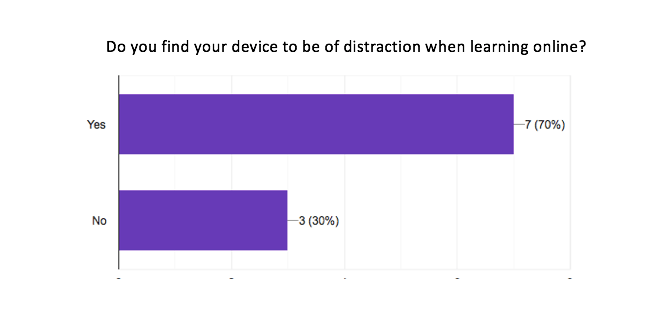
An online article written by Insight Higher Ed dating back to 2019, announced that this distraction with devices can be due to a non-classroom environment allowing students to slip into poor habits and comforts on these devices that lead to the distraction. This is due to the freedom provided of university learning not being in an class roomed environment making students more susceptible to the device being of a distraction as this environment holds students less accountable.
Research
The research conducted in this project is valid and of value to students, universities and academics interested in exploring this topic. With all research complying with the necessary guidelines ensuring the project was performed in an ethical manner. It is important to clarify that my primary research could only be of a limited size, type and doesn’t reflect or speak for all university students on the topic. It does however provide more intimate data of merit, relevance and should not be discredited, but be aware of restriction in time, finance and research in order to complete this project. Meaning for readers that the evidence of the research is strong but ultimately confined.
Overview
In summary the project discovered that students are mainly using laptops for their online learning, as it is widely acknowledged to be the most suited to cover the requirements of online learning at a university level. Yet, it proved that devices selected by students is more complex than using the device most effective with other contributors being comfort, habit, distractions, value and location also playing roles in the relationship between a student and their chosen device. Demonstrating that even though most students use laptops as it is most effective, students will still use a device in which they believe works best for them and meets their own needs regardless of laptops being best suited to handle the requirement of online learning for university students.
Conclude
This project required a commitment to a high standard of research in order to gain quality and useful information that would be of contribution to this topic. Which is why I have decide to reflect on the project and research in order to evaluate what was done well and things that could be done differently if required to research in the future.
If you feel inclined you can read about this in the link below.
Reference
- Asurion. 2020. Laptops vs tablets: what’s the difference and which is best for students? (Online) Available at: <https://www.asurion.com/connect/tech-tips/laptops-vs-tablets-which-is-better-for-your-students?>
- Hazelrigg, N., 2019. Survey shows nearly half of students distracted by technology / Insight Higher Ed.
https://www.insidehighered.com/digital-learning/article/2019/07/10/survey-shows-nearly-half-students-distracted-technology(Accessed 21 May 2021)
 highfieldonline.photo.blog