BCM241: Research Project Pitch

As discussed in my previous BCM241 blog post’s my chosen media niche is podcasts. Podcasts seen to many as the digital transition from radio started emerging roughly in the 1980’s-1990’s before catching hold in 2004 where the medium has seen an exponential growth in the past 15 years. Podcasts have also contributed to the increased media diversity society is now exposed to with many preferring to consumer their media online compared to offline. With the mediums ability to personalise the political it provides viewers with alternate ideologies and beliefs in contrast to mainstream media on important issues.
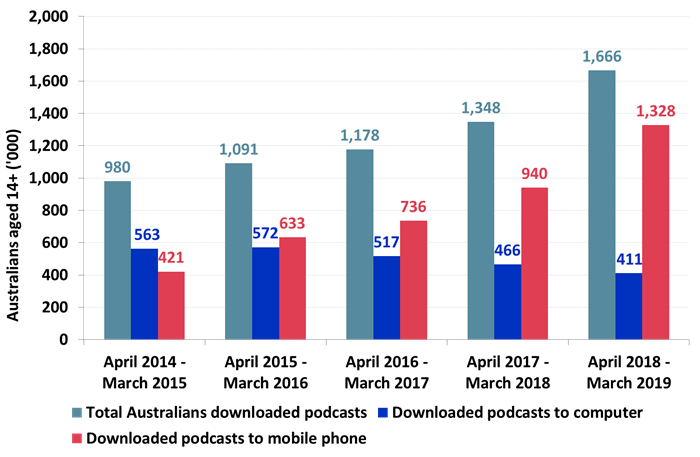
New surveys find younger listeners driving podcast downloads in Australia,  New Zealand - RAIN News
Bar graph – Highlighting the growth in Australian’s consuming podcasts over the 5 years. (Image founded on Google Images sourced from RainNews)

Which is why my ethnographic research project involves the study of my specific media niche of Joe Rogan’s podcasts to determine if by listening it has shifted viewers ideologies and perceptions on important and controversial issues. It is through this research project that I hope to be able to decide the value of podcasts as an independent media.

Joe Rogan takes popular podcast exclusively to Spotify in $100 million deal
Joe Rogan’s Podcast – the specific podcast of my research (Image found on Google Images sourced from YahooSports)

Digital Artefact

It is from my research project that I will use this information to create a digital artefact. My artefact will be distributed over a few or singular digital channels such as WordPress, Instagram or Twitter where it’s essence will be to provide viewers with podcasts links covering important or controversial issues. Providing followers with extra opinions and information on these topics whilst also providing a platform for viewers to be introduced to new podcasts or the medium itself.

The video attached below, explains in detail the topic and process of my research project.

References

  • Lundstrom, Markus and Lundstrom, Tomas Poletti (2020) ‘Podcast Ethnograph’, International Journal of Social Research Methodology, online first issue.
  • Mertens, Donna (2014) Ethical Use of Qualitative Data and Findings, The Sage Handbook of Qualitative Data Analysis (edited by Use Flick), Sage: Los Angeles, 510-523.
  • Geertz, Clifford (1973) ‘Thick description – Toward an interpretive theory of culture’, in the Interpretation of Cultures, Basic Books New York.
  • Hasbrouck, Jay & Taylor & Francis 2018, Ethnographic thinking: From method to mindset, Routledge, New York, NY.

#medianiche #BCM241 #podcasts #researchproject #ethnography.

Ethical considerations & Background Research: Media Niche

The purpose of background research is to allow an ethnographer to discover relevant research that has already been done a topic. It is through conducting this background research that I was be better able to understand my media niche (Joe Rogan Podcasts) whilst also providing new perspectives towards my analytical framework and field research.

As discussed in Week 3’s blog post, my motive behind my research process regarding my media niche is to determine that whether listening to a podcast specifically Joe Rogan’s, seeing if it has shifted viewers ideologies and perceptions on important issues. Thus allowing me to decide the impact podcasts have as an independent media.

Background research

During my background research I found in particular these two academic sources the most useful towards my ethnographic study.

The first being a study conducted by the University of Technology Sydney which explored the impact of digital platforms on news and journalistic content. This research enabled me to better determine the value of podcasts as an independent media whilst providing me with the following data:

  • Australians are consuming more news more often, preferring online access over offline, however traditional media is not dead.
  • Digital platforms (podcasts) can now be regarded as key participants within the broader framework of news media, although they are not publishers, but their role of distributors is becoming increasing present.
  • Digital platforms (podcasts) have changed the news. As these platforms provide a point of access to news a function formally performed by media companies.
  • Algorithms (internet marketing) largely determine which content news consumers get to see. For example the more podcasts a consumer watches online increases the likelyhood that podcasts suggestions will come up on the consumers feed.

The second academic source is an online article by The Conversation , it was from within this article that I was able to extract data to help determine the value of podcasts shifting peoples ideologies and beliefs with my finding including:

  • Podcasts personalise the political to captivate their audience and inspire change (Mchugh, 2017).
  • This personalisation of podcasts can lead to activism. For example the podcast Listen To Love contributing to the increase in activism experienced during Sydney’s same sex marriage protest.
  • Podcasts contribute largely to viewers public spheres where socialising can include topics discussed from within recent podcasts watched.
  • The value of podcasts as media is still being researched however it has grown expediently within the past 15 years.
Same sex marriage rally in Sydney, sunday August 9, 2015. - ABC News ( Australian Broadcasting Corporation)
The power of podcasts – shot of Sydney’s same sex marriage protest (Image found on google images sourced from ABC)

Ethical issues

During my observational and ethnographic research process I will need to assess my own values and principles whilst ensuring I respect the consent, privacy and ensure no harm to the well-being of my participants within my field work (Mertens, 2014). I must also be objective with my finding and with any deception of participants justified.

As mentioned in Week 3’s blog post, I will no longer be collecting data via viewers comments left below Joe Rogans Podcast on Youtube. The ethical issue I am presented with is privacy and intellectual property meaning I don’t have consent nor permission from both the platform and the viewers to use their comments for my ethnographic reseach. To overcome I will instead describe explore my experience within the podcasts seeing if by listening it has changed my ideologies and perceptions on controversial and important issuses.

References

  • Mertens, Donna (2014) Ethical Use of Qualitative Data and Findings, The Sage Handbook of Qualitative Data Analysis (edited by Use Flick), Sage: Los Angeles, 510-523.
  • Winter, Rachel and Lavis, Anna (2020) Looking, But Not Listening? Theorising the Practise and Ethics of Online Ethnogrpaghy, Journal of Empirical Research on Human Research Ethics Vol. 15(1-2) 55-62.
  • Mchugh, S., 2017. Truth To Power: How Podcasts Are Getting Political
  • ACCC, 2018. Centre for Media Transition: The Impact of Digital Platforms on News and Journalistic Content

#bcm241 #podcasts #ethnography #joeroganexpereince

Research Process: Media Niche

The purpose of a research process is to identify, locate, assess and analysis information to help your ethnographic research. To achieve this I must brake my research process down into three key elements:

  1. Problematise my approach when conducting a media ethnography
  2. My research plan
  3. The schedule of my research

Problematisation

As discussed in Week 2’s blog post, problematisation essential means a problem that requires a solution. In this case I will be investigating the impact of my media niche (Joe Rogan’s Podcast) and determining that if by listening it has shifted viewers ideologies and perception on important issues. For example, prior to listing to the podcast the viewer was anti-vaccination but after listening to the podcast turned pro-vaccinations. It is through this investigation and ethnographic research that I hope to be better able to determine the value of podcasts as an independent media that is capable of altering viewers beliefs and their paradigm of the world.

When investigating my research I plan to target existing viewers of the podcasts and also those unfamiliar of the niche and introduce them to the podcast and establish that if by listening the viewers ideologies have remained the same or changed.

Additionally, I hope to explore new experiences around my media niche and gain an insight into the environment of how viewers listening to the podcast (e.g. Phone or laptop), where they listen, when they listen & why they listen to help provide interesting data as a result of my ethnographic research.

Research Plan

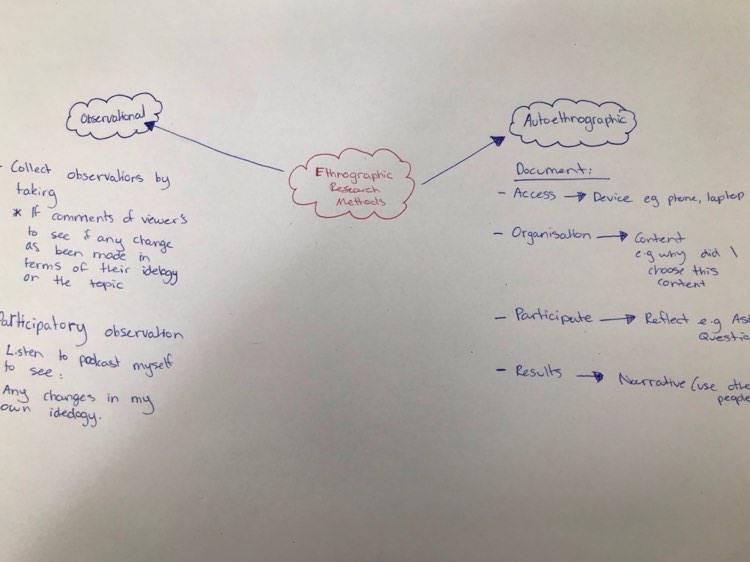
The research plan is to help move your ethnographic research from general to specific. I plan to make this switch by using both observation and autoethnograpic research methods when conducting my research. The way in which I will be using both methods to gain information can be seen in the diagram attached below.

Mind Map Diagram : Ethnographic research methods

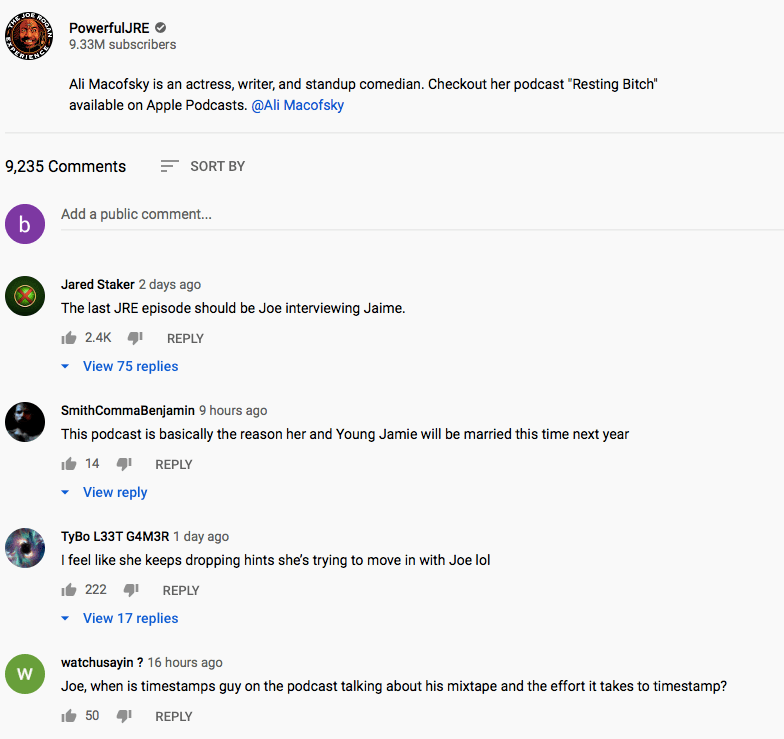
I will record the information gained from both research methods on a word-document on my laptop where I will document my observations on the topics outline in the diagram attached above. I will also be taking screenshots from viewers comments on the podcasts streaming platforms such as Youtube to see if it has changed the viewers perception or belief on the topic. I will be recording this information weekly to ensure correct and current information is provided.

An example of the types of screening shooting I will be recording

Research Schedule

Also known as research protocol, the research schedule is essential an outline of what I’ll be recording and when. This will help enable me to keep my ethnographic research relevant and concise. Below is an outline of my research schedule from Week 4- 7.

Week 4: I will be researching the access to the podcast. Meaning if my experience of my niche is altered by using it on my phone or laptop. How to find, where can you stream it (Youtube etc), where to find it on social media, if my experience is altered when listening at home compared to in the car.

Week 5: I will be studying the chosen content off podcasts:

#459 – Dr Rhonda Patrick: https://www.youtube.com/watch?v=FApCVOXoweU

#543 – Sam Harris: https://www.youtube.com/watch?v=ZA106wrMUe4

#1246-Alex Berenson & Dr Michael: Hart: https://www.youtube.com/watch?v=YHwSmwEwmV4

As I believe these are some of the most controversial and influential podcasts that might result in the changing of viewers ideologies towards the topic and as a whole, with that being my key research in week 5.

Week 6: Will be research of how other people are viewing the podcast, how are they finding the podcasts.

Week 7: I will be viewing other podcasts such as The Monday Morning podcast. It is from this podcast I will be researching if it is having more, less or the same impact in regards to altering their current beliefs and ideologies on important issues.

Overall, it is by braking down these three elements that I will be able to clearly and more precisely undertake my research process which will in turn enable me to explore new experience within my media niche to provide interesting and relevant information.

Reference

  • Geertz, Clifford (1973) ‘Thick description- Toward an interpretive theory of culture,’ in The Interpretation of Cultures, Basic Books New York.

#bcm241 #medianiche #ethnography #joeroganexperience

Narrowing my media niche

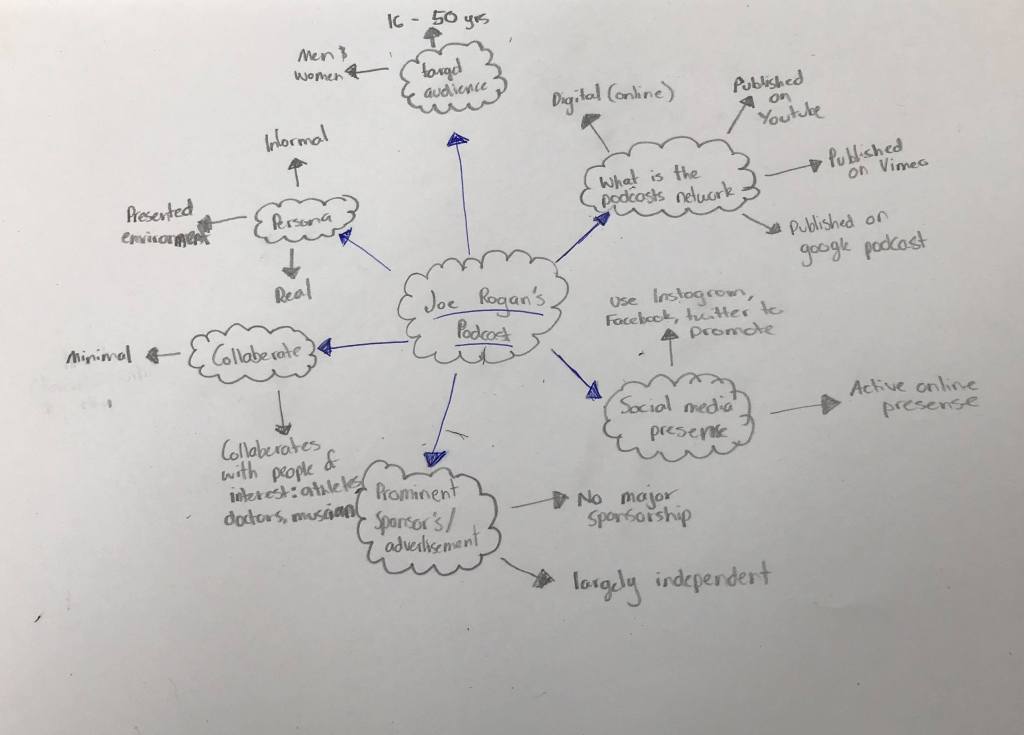
From my blog post in Week 1 where I selected a media niche. From that is a continuation in this blog post where I begin to narrow my research on that specific media niche to a field site. A field site is not just a single physical or online space, but a network of relations. To help capture this I have used a diagram attached below to help visualise elements of Joe Rogan’s podcast such as persona’s and social media presense that I think will be relevant to my investigation.

Mind Map Diagram of my media niche

Exploring Joe Rogan’s podcast Ethnographically

By exploring Joe Rogan’s podcast it will enable research to provided information about the presence of the podcast has outside its apps. Enabling a greater understanding of the impact the podcast is making in regards to peoples ideologies and perspectives, and if they have altered since listening to the podcast. This knowledge would be critically when presenting my research as it will enable me to better determine the value of the podcast and podcasts in general as an independent media platform that helps change and challenge peoples paradigms that have been formed as a direct result of consuming daily the conventional and biases views of mainstream media. It is from this research that I will be able to develop my ethnography skills of perspective, conceptualising and reflexivity.

Interest in my finding

Large media corporations such as The Daily Telegraph might be interested in the findings as media and politics is often intertwined. Large media companies might have a specific interest regarding the impact a podcast is having in relation to providing a greater independant media diversity and the scale of the impact they are providing towards the shift in ideologies and beliefs specifically towards media issues. Unfortunately I don’t think these findings will have much relevance to my current future career of marketing specialising in advertising although some section of research conducted could provide limited use to the marketing industry.

Problematising this media niche

Problematising essential means a problem that requires a solution. I would begin problematising by identifying the problem which in this case is determining the impact Joe Rogan’s podcast is having in term of shifting peoples ideologies and perceptions on important issues. Following this I would then start shaping a question that could be answered qualitatively (non- numerical). For example viewers could be asked to answer that since listening to the podcast if their ideologies have changed or shifted. It is through correctly problematising that I will be able to gain data that will help me understand the value of my media niche.

Exisiting research on the media niche

When conducting my own research I found some an interesting scholarly research which studied how Joe Rogan’s new exclusive Spotify deal could change the podcast business. The respective periodicals are attached below.

Joe Rogan's podcast is moving exclusively to Spotify - Business ...
Image found on google images and taken from Business Insider Australia

Reference’s

  • Hasbrouck, Jay & Taylor & Francis 2018, Ethnographic thinking: From method to mindset, Routledge, New York, NY

#bcm241 #podcasts #joeroganexpereince #independantmedia

BCM241: Media Niche

Media is powerful. Media when communicated correctly has the ability to change and shape peoples paradigm of the world. Essential meaning that through the spread of information and knowledge media has the ability to influence societies ideologies of the world we live in.

My interest in media was evoked by media evolving into a digital age of internet, laptops and smart phones with this allowing media to become more accessible and present occurrence in our daily lives. Which was why it was important to me to understand the media I consume as it will enable me to better form my own ideology of the world we live in.

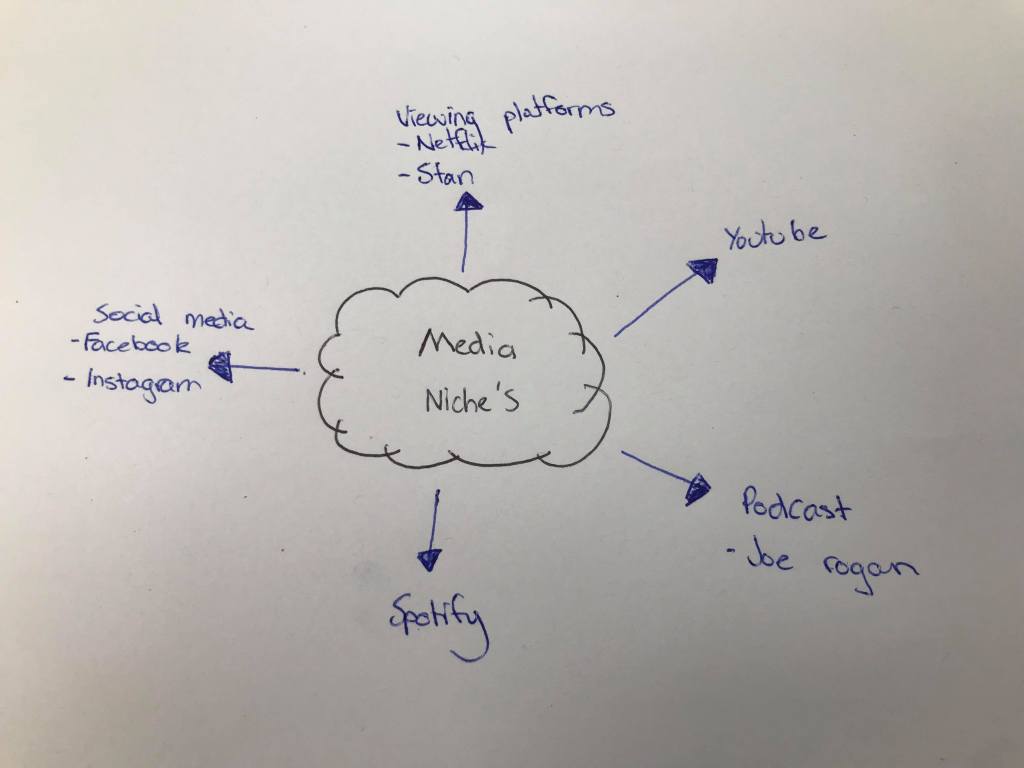
While I have a general and overall interest in media, I have used a mind map (as seen below)in order to identity and narrow down media niche’s in which I would be interested in developing enabling me to specify a specific niche.

Mind map diagram

What is my media niche ?

It is through the mind map that I was able to identity a specific media niche’s that I would be interested in developing for my digital artefact with that being a podcast specificically Joe rogan’s.

Podcasts: Joe Rogan Experience

A podcast is a recording of audio discussion on a specific topic. I find podcasts so interesting because they are a dynamic medium that can be delivered across serval platforms. For example, Joe Rogan’s podcast can be viewed on Youtube with snippet on both Instagram and Facebook whilst recently signing an exclusive licensing deal to Spotify.

I am also fascinated by the impact podcast create with the media now transitioning into a digital era. It now enables people to become their own media giving them a voice with anyone able to create a podcast and push their own ideologies and beliefs regarding controversial areas such as politics ultimately resulting in an increase of diversity in media ownership.

This can be seen through Joe Rogan’s podcast where he sometimes challenges the conventional views of mainstream media providing the audience with his alternative ideologies and perspectives in regards to important issues. With the podcasts presence inspiring the audience to think more independently about the world and to challenge the agendas set by the mainstream media and form your own opinions and values.

JAM Nation with Jonesy & Amanda
Image found on google images and taken from iHeartRadio: https://www.iheart.com/podcast/269-the-joe-rogan-experience-27959911/

Joe Rogan’s podcast is one of the worlds most watched podcasts dominating competitors due to the diversity and profile of guest varying from athletes such as Laird Hamilton to scientists Lawrence Krauss which most competitors can’t match due to his network of contacts and greater available funds and resources helping contribute to the quality of the experience. Another advantage the podcast holds over competitors is Joe Rogan’s large international presence as an American comedian and Mixed Martial Arts commentary allowing him initially not to focus on advertisement since he already has a large existing online and social media presence.

Overall I think it is important to investigate the media niche of podcasts and their contribution to creating an increase in media ownership diversity digitally.

Reference

  • Daymon Christine and Holloway Immy (2011) ‘Ethnography”, Qualitative Research Methods in Public Relations and Marketing Communication. Routledge: New York.

#bcm241 #ethnography #medianiche

Deceptive and Misleading advertisement

Deceptive and misleading advertisement is when a business makes false claims or impressions to consumers on price, value or quality of goods and services on offer. It is also unethical and illegal for business’s to engage in conduct that misleads or is deceptive to consumers under the Australian consumer law section 18. With this law still applying even if the business did not intent to mislead consumers as all information wasn’t provided to enable a good decision, directly impacting the consumers as they have wasted money on a product or service that did not meet the expectations guaranteed.

Trivago versus the ACCC

A recent example of this complex legal issue is the case between trivago a travel site company that finds the cheapest hotel bookings (supposedly) against the Australian Competition and Consumer Competition (ACCC) whose main purpose is to enforce legislation that protect consumers.

The ACCC believe Trivago is giving consumers false and deceptive information on which hotel booking is the cheapest. With the ACCC chair Rod Sims’s stating ” the business was using an algorithm to place significant weight on hotel booking’s that paid them the most cost per click as it is the business’s main source of revenue” (Trivago misled consumers about hotel room rates, ACCC, 2020). Basically meaning that Trivago’s hotel ratings were based primarily on which hotel booking site paid them the most. The ACCC has also accused trivago of using strike pricing methods where the business used higher price hotel offers as “top position offers” for more than 66% of listening over alternative lower priced offers. The business even using text in different colours (red versus green) giving consumers a false impression of saving.

ACCC Sues Trivago For Misleading Comparison Claims | LoyaltyLobby
An example of trivago using deceptive “strike through pricing” method’s on hotel price’s tricking consumer’s.

However, Trivago claim best isn’t always the cheapest in order to defend the claims made by the ACCC. With Neil Young representing trivago saying “that advertiser’s payments were the fourth or fifth most important factor with advertisement royalties”. Young also denied the use of the business false strike pricing strategy explaining ” there is more factors at play than simply price with the deals comparing hotel room size (Chanthadaong, 2020).

Which essentially means that if the ACCC can prove to the federal court trivago engaged in conduct that was misleading and deceptive breaking the Australian consumer law section 18 the business will be facing serious penalties.

The implantations of the case?

Unfortunately, for trivago the business has lost up to more than 20% of their customer base since being taking to court in 2018. Resulting in the media provoking bad publicity about the travel site company. Essentially making aware to many consumers to avoid trivago when looking for cheap hotel prices unless they wished to be tricked or deceived.

The ACCC have also taken the company to court over misleading information on a television advertisement where the business featured false representations of hotel prices. The advertisement airing more than 400,000 times from late 2013 to mid 2018 stopping the advertisement ultimately once the case against the ACCC began (“Absolutely outrageous” Trivago misled customer on hotel pricing, Khadem. N, 2020). With these circumstances severely hindering trivagos reputation as a consistent and reliable travel site amongst travellers resulting in a heavy loss of revenue, greatly affecting the businesses livelihood if trivago is proven guilty, it is expected they face substantial fines and penalties.

Trivago’s television advertisement which the ACCC believed mislead consumer’s

The case between trivago and the ACCC has also put other sites similar to the business such as Hotel Finder, HotelsCombined and Skyscanner under heavy suspicion by consumer watchdogs the ACCC. Where they have sent a strong statement that “if other businesses are caught misleading consumers through the use of false or deceptive advertisement they too will be taken to court”. It is through these claims and this tough scrutinisation of businesses that the ACCC will hopefully encourage companies to act and operate in a more professional and ethical manner. Allowing consumers to feel safe when booking hotels online through travel site businesses.

Results

On Monday the 20th of January 2020, the federal court ruled that travel comparison site trivago misled and used deceptive advertisement on it’s website and television advertisement.

Where trivago has been found quality of the following breaches:

  • Cheapest price representation: Where the businesses cheapest hotel room offer didn’t appear on their website. This fact alone was enough to render the cheapest price representation as misleading and deceptive breaking section 18 and 24 of the Australian consumer law.
  • Strike through price representation: With the businesses online comparison false and misleading as it was found that trivago compared offers for a standard room with luxury rooms using red and green text accompanied by juxtaposition to trick consumers into thinking that they were finding the cheapest price hotel (Major ACCC Win, Federal Court rules trivago misled customers, HWL Ebsworth Lawyers, 2020), again, meaning trivago breached section 18 of the consumer law.
  • Top position representation: Trivago was proven to have used an algorithm where the cheapest hotels offered, was simply what hotel paid them the most. Ultimately meaning the business again violated section 18 of the Australian consumer law.

Resulting in a major win for the ACCC whilst applying pressure to sites similar to trivago to operate in an ethical manner. It is said that trivago have been faced with millions of dollars in fines and penalties as result of losing the case.

Key take-aways

The decision highlights the importance for businesses to be ethical, truthful and aware of the claims that they make to consumers about price, value or the quality of goods and services provided. To ensure their marketing and advertisement is not misleading or deceptive to guarantee businesses comply with the Australian consumer laws.

References

The Public Sphere

Jurgen Habermas was responsible for creating “the public sphere” theory in 1962. The theory was essentially a space where individual’s in society most typically the middle class could find out what was happening regarding social, cultural and political issue’s. This space also allowed individual’s to engage in common concern’s and debate on idea’s for what should be done.

Public sphere - encyclopedia article - Citizendium
Diagram: The public sphere

Where is my public sphere?

Like most my public sphere is with friends where we share idea’s and engage in intriguing or important issue’s that we have seen or heard of via the media.

Although social media platform’s such as Facebook and Instagram have provided a new digital public sphere with little exclusion, as the platform’s enable all user’s to share their view’s and information whilst also providing a place to debate any common concern’s.

Facebook logo, label, logo, website icon
One of the few social media platform’s which changed the shape of where and how public sphere’s operate.

How does it operate?

When amongst friends we simply share our idea’s on issue’s. Which makes it interesting has we all share different ideologies meaning we don’t share the same view’s on certain issue’s which makes it interesting.

While online is different because social media apps again such as Facebook and Instagram produces a much greater scale of feedback where people I don’t necessarily know can share their opinion’s and value’s on important issue’s within the world.

What are the issues that come up?

The issues that come up in both my public sphere’s largely depend on the media, which provide the information whilst provoking the debate about certain issue’s

Who is included?

Generally just friends, but while on social media it enable’s most individual’s to get involved in the debate.

What role does the “media play” in all this?

The public sphere is a concept (idea) which can be seen as a metaphor for thinking about how individual human beings come together to exchange idea’s and information about what matter’s most to them in a “liberal” society. This concept has been highly theorised (applied, written about and debate) in relation to the media. Where the general consensus is the public sphere is strongly mediated due to these main two reason’s:

  • The media provide us most the issue’s in which provoke debate
  • People also use media platform’s to debate issue’s and idea’s

Overall the public sphere is a dynamic environment where people’s view’s, idea’s and value’s and constantly evolving in relation to what matter’s most to them in regard’s to society.

Reference’s

  • Bruns, A. and Highfield, T. ‘Is Habermas on Twitter? Social media and the public sphere’, https://eprints.qut.edu.au
  • Fuchs, C. “Twitter and democracy: a new public sphere?’ In social media: a critical introduction’,.

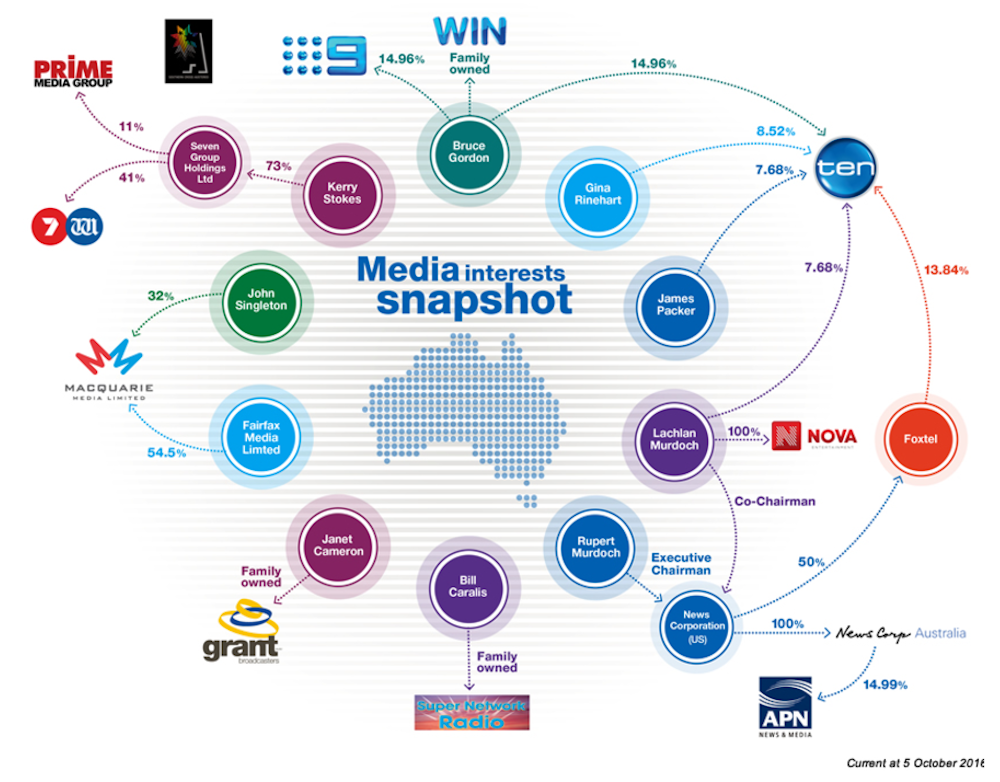
Media Industries and Ownership

The main purpose of the media is to spread information and knowledge to society, but it is so much more powerful than that, with the media being so important because it has the ability to influence society. Helping shape people’s ideology of the world we live in.

But the media is evolving into a digital age of the internet with platform’s such as Facebook being so accessible and efficient providing all user’s an opportunity to have a public opinion, with this advancement of technology and information seening a decline in media ownership globally.

Who “Own’s” and “Control’s” the media I access for the new’s ?

The main media platform’s I use in order to access the new’s include:

  • Channel 7 owned by Seven West Media and also remain’s Australia’s most-watched and trusted television news service.
  • Facebook owned by Mark Zuckerberg
  • Instagram owned by Facebook Inc
  • The Daily Telegraph owned by Telegraph Media Group
FactCheck: is Australia's level of media ownership concentration ...
Australia’s owned media overview

The media in which I am exposed to matters because it influence’s what information I consume and that media’s platform’s particular view on how society should be run. Which is often controversial resulting in contested ideology where media platform’s opinion’s and value’s conflict on examples such as climate change. With the media I observe mattering because it has a direct correlation on how I might view the world.

With the above being my main media platform’s in order to stay in touch with the new’s. I am also influenced through the mass medium’s of television and radio with Max Herkhelmer a student of Frankfurt’s school of thinking believing that mass culture medium’s produce culture ideologies that people have no choice but to accept. This being a direct reference to pop-culture which is often perceived as being low in culture between the divide of higher and lower class. With the entertainment industries also guilty of projecting their view’s and opinion’s on topic’s showcasing too how it can be seen as a form of media.

What trust is there in new’s source’s?
Trust in the media is earned by consisted and reliable information and knowledge enabling society to make an informed opinion about current issue’s in the world. However media platform’s with unreliable information is often quickly discredited and is seen as fake new’s where it consistently struggles to repair their fanbase due to this lack of trust.

Our History — The Betoota Advocate
“The Betoota Advocate” often referred to as fake new’s puts a comedic spin on current news topic’s

Although with Louis Altusser on-going suspicion with the role of media simply viewing the media as an ideological state institution trying to portray the idea of never fully trusting the media. As he perceive’s the media more as a source of propaganda with minimal trust almost as a way to control how society determine’s the world to be rather than letting society itself critically think and produce their own independent thoughts.

Overall media is a daily occurrence in our live’s and it is up to us the individual to make our choice’s and opinion’s from the knowledge and information the media provide’s to create our own ideology.

Reference

  • Lidberg, J.2019 ‘The distortion of the Australian public sphere: media ownership concentration in Australia ‘, AQ, Australian Quarterly, vol.90, no. 1, pp. 12-20

Audience’s

“One of the most intriguing aspects of the media audience is that most media audience’s don’t exist”- Sue Turnbull. Compared to that of a highly visible and audible audience of a Nation Rugby League (NRL) match. Generally referred to as a crowd, NRL games mostly attract an audience of those fan’s whose two team’s are playing or have a generally interest in rugby league where the audience exist in a specific place (stadium) and time.

How I found the experience?

I found the experience interesting as most fan’s divide themselves in cluster’s around the stadium of those who support the same team splitting the game’s audience into two sides. This divide adds to the experience of watching the game live with the audience often being more vocal (cheering and booing) at different times depending on their teams performance or the result at the end of the game. What I also found intriguing is that an audience is an experienced shared between those present but the experience can differ for individual’s depending on their team’s result . Having direct coloration on how the individual interpreted the experience of the match. What else I became fascinate with is the idea that not all NRL follower’s will turn up to a match with scattered viewing due to the ability to watch the game from home for those can’t travel. Another factor is the variety of matches being played at different times and places throughout the weekend with matches being held Thursday through to Sunday. I also found during my experience their is minimal use of electronic device’s with the audience’s direct attention on watching the outcome of the game resulting in no distracted viewing of multiple screen’s. When in comparison to watching the game live on television from home the audience can afford to use electronic device’s as it provide’s replay’s and extended commentary allowing the audience the opportunity to have split attention.

Image result for nrl crowd cronulla
Typical NRL crowd set up

Negative’s

The only negative’s from this experience is depending on your positioning within the stadium that sometime’s the viewing of the action can be difficult . For example if you are positioned on the southern end of the ground action on the northern end can be tough to see but most stadium’s will provide a large television to make viewing easier for this reason. Another negative can also be the blocking of view from another member in the audience and although rare and often momentary it can sometime’s lead to the missing of live action.

Unspoken rule’s of the audience

One of the biggest unspoken rule’s that I found when attending an NRL match is when your team win’s you stay back after to cheer the team song. Also sledging is allowed through out the game even when a player is taking a conversation. Lastly another unspoken rule is that most of the time the audience tries to hold off using the toilet’s until half or full-time.

But overall I throughly enjoyed my experience and the atmosphere an audience can provide to an NRL game.

Image result for nrl streaker
One of the crowd favourite’s

Reference

Digital Artefact

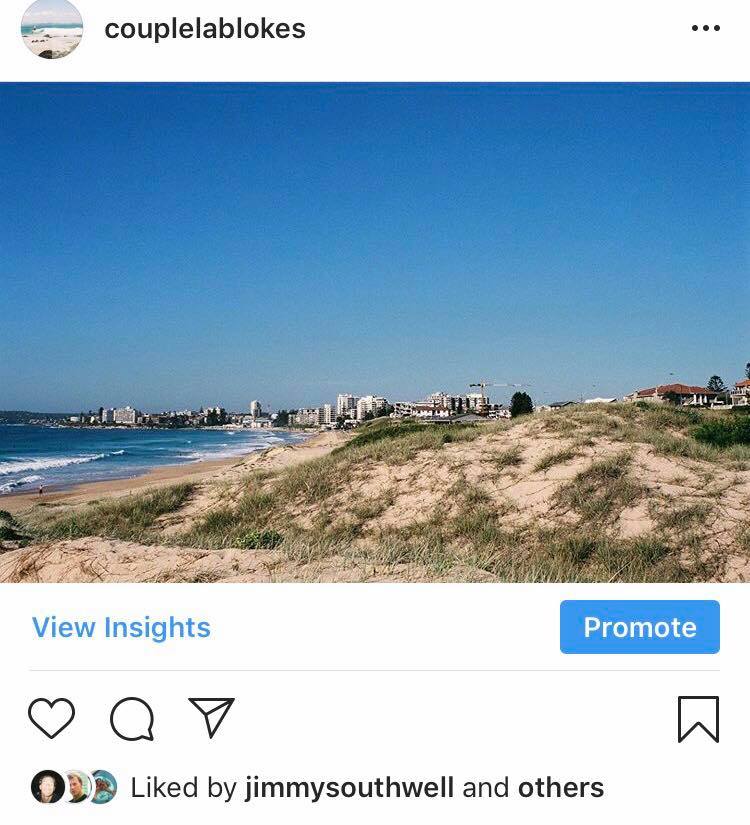
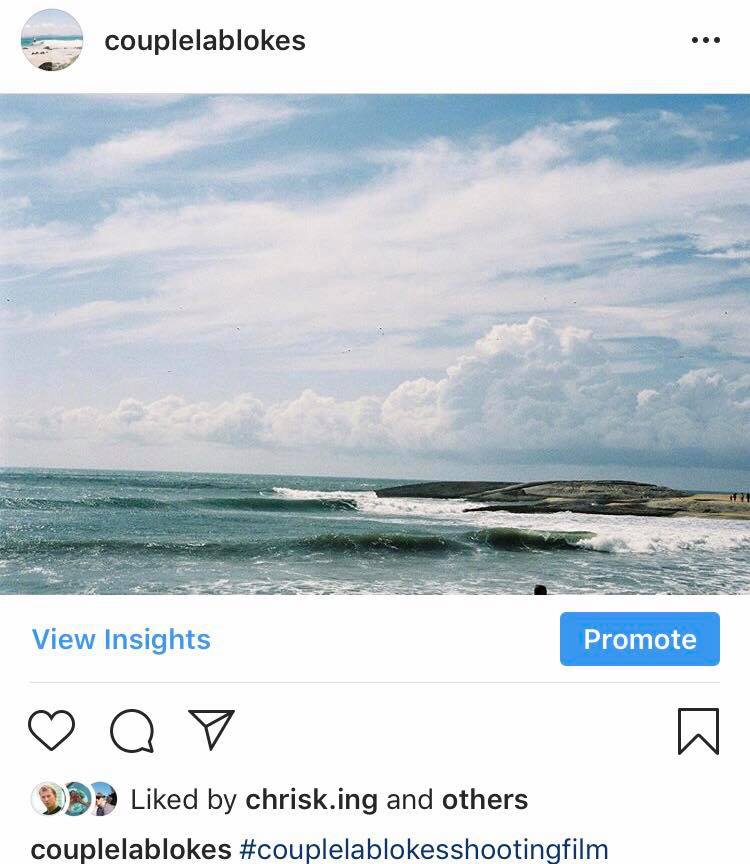
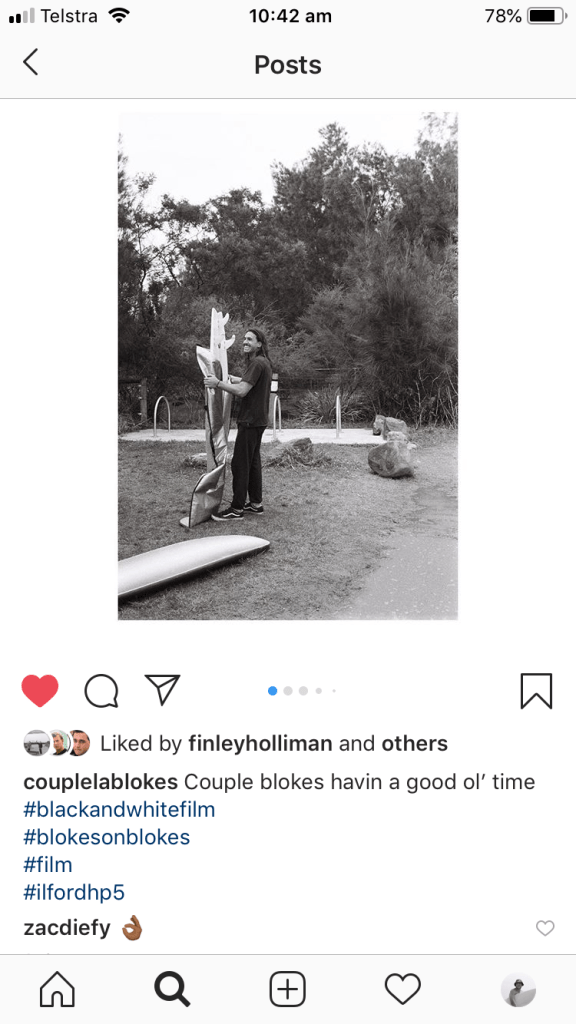
My digital artefact, Couplelablokes is a film based photography page on Instagram. Where I upload images taken by myself with content being centred around beach/surf culture, people and events.

How it works ?

The page work’s by uploading pictures previously or recently taken to Instagram daily that have been:

  • Taken by myself
  • Is film not digital
  • Fits the beach/surf culture, people and events

I analyse these steps to ensure the pages content and theme is not lost and is easy for followers and potential viewers to understand, grasp and engage with.

In order for Couplelablokes to work and exist I also need the following pieces of equipment:

  • Cannon EOS 500 camera
  • Film
  • Iphone
  • Instagram
  • Laptop

It is through, understanding how my digital artefact works that I have been able to better use different methodologies around uploading content to Couplelablokes, enabling consistent content giving the page a clearer value to viewers.

Iterations/progression

Couplelablokes over its short span of 9 weeks have seen two major iterations to the page has a direct result of audience engagement and lack there of.

With the first change being that the page now uses hashtags with every post made. To help improve the limited involvement and connection I receive from my audience whilst also being a useful tool to reduce the effect of Instagram’s algorithm and reach new audiences.

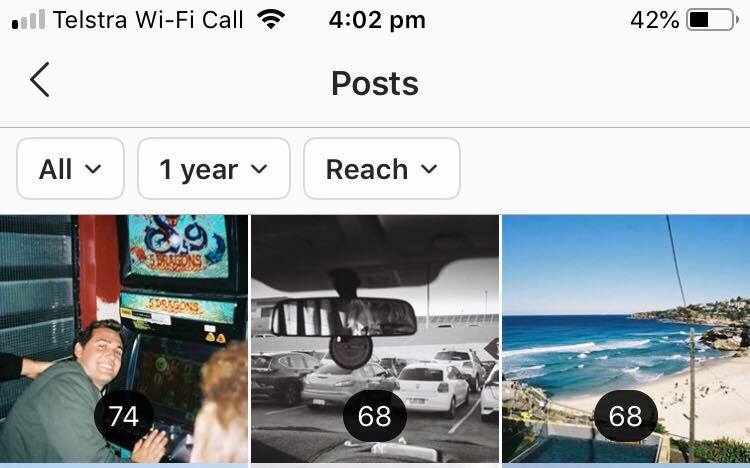
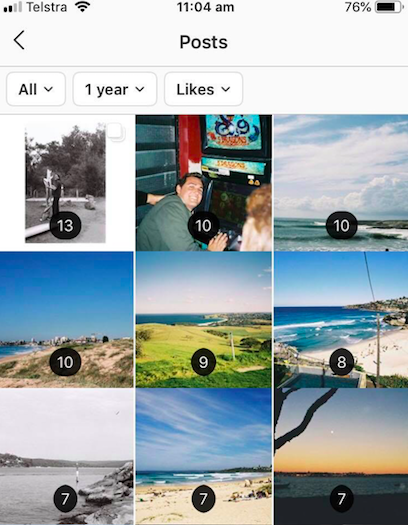
The other iteration to the page can be seen in its content where I have now starting uploading more pictures centred around people as a direct feedback from the audience analytics. As seen below

Audience analytics I have used resulting in the pages content iterations

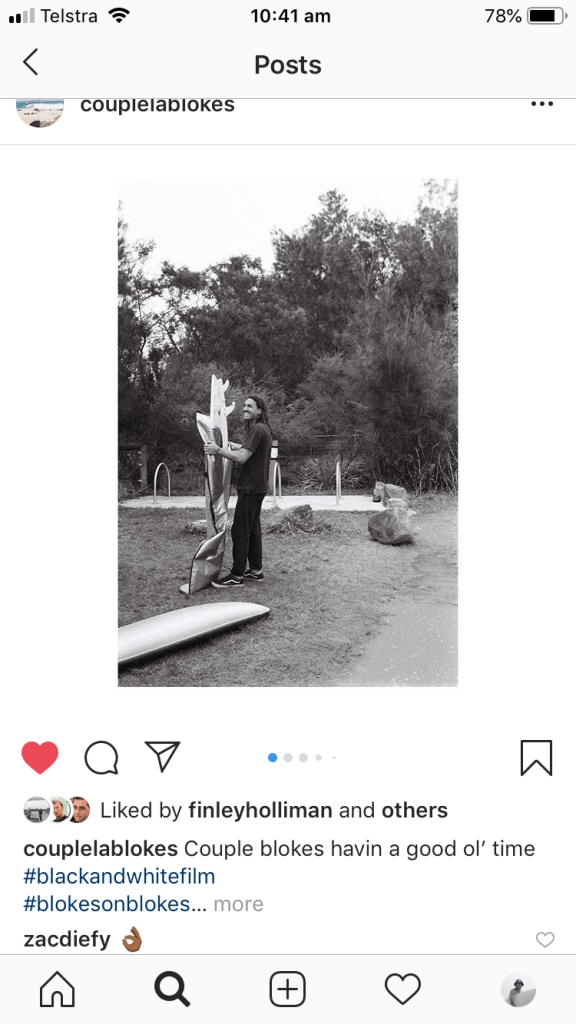
By doing this, it has result in the increase of page interaction and engagement with the page recently reaching its highest amount of likes in a recent post which feature content centred around people.

I found these two moments of iteration an important learning curve in my digital artefacts progression, as it taught me to listen to audience feedback and analytics in order to keep the page relevant and popular amongst followers and also to look for new methods to reach audiences and increase engagement to avoid plateau.

Utility and value of Couplelablokes

Couplelablokes provides value to:

  • People with a passion and interest in film photography
  • People who appreciate beautiful coastlines and amazing beaches, people and events

Whilst I believe, my digital artefact has an intrinsic ability to inspire people to take more photos or learn photography to better capture life’s moments and share them with the world. Though the page itself has also provided me with the utility to connect with like minded people where I have drawn inspiration from pages such as:

The future trajectory of Couplelablokes

I am hopeful my digital artefact Couplelablokes will continue to grow with constant management of analytics from my audience and their feedback resulting in further iterations of the page to maintain it’s relevance avoiding plateau. Whilst continuing to work on strategies and methodologies to ensure consistent audience engagement and awareness to promote the page my digital artefact will keep progressing into the future.